

Digital authority for real estate agencies
Authority is not claimed: it is demonstrated in multiple places.
An agency conveys trust when its website, profiles and content, its authors and external references form a coherent identity. The goal is not to accumulate links, but to build signals that help users and search engines understand who the company is.
The most common mistake
Confusing authority with backlink volume
Thousands of irrelevant links do not replace a coherent presence. An agency needs references related to its market, identifiable authors, strong service pages and consistent corporate information.
Links without context
Backlinks from irrelevant or automated pages add little value and can undermine trust.
Fragmented brand
Name, address, team and services appear differently on each platform.
Anonymous content
Articles do not show who wrote them, what experience they have or how the information was verified.
Digital authority grows when other sources can confirm what the agency says about itself.
Authority framework
Six layers that should reinforce one another
Corporate entity
Clearly defined name, contact details, location, team, services and areas.
Demonstrable expertise
Visible authors, guides, case studies, processes and local knowledge.
Useful content
Resources that address real buyer and seller decisions.
External profiles
Directories, maps, portals and networks with consistent information.
Editorial mentions
Natural references on websites related to property, investment or local life.
Trust signals
Reviews, policies, legal information, contact details and commercial transparency.
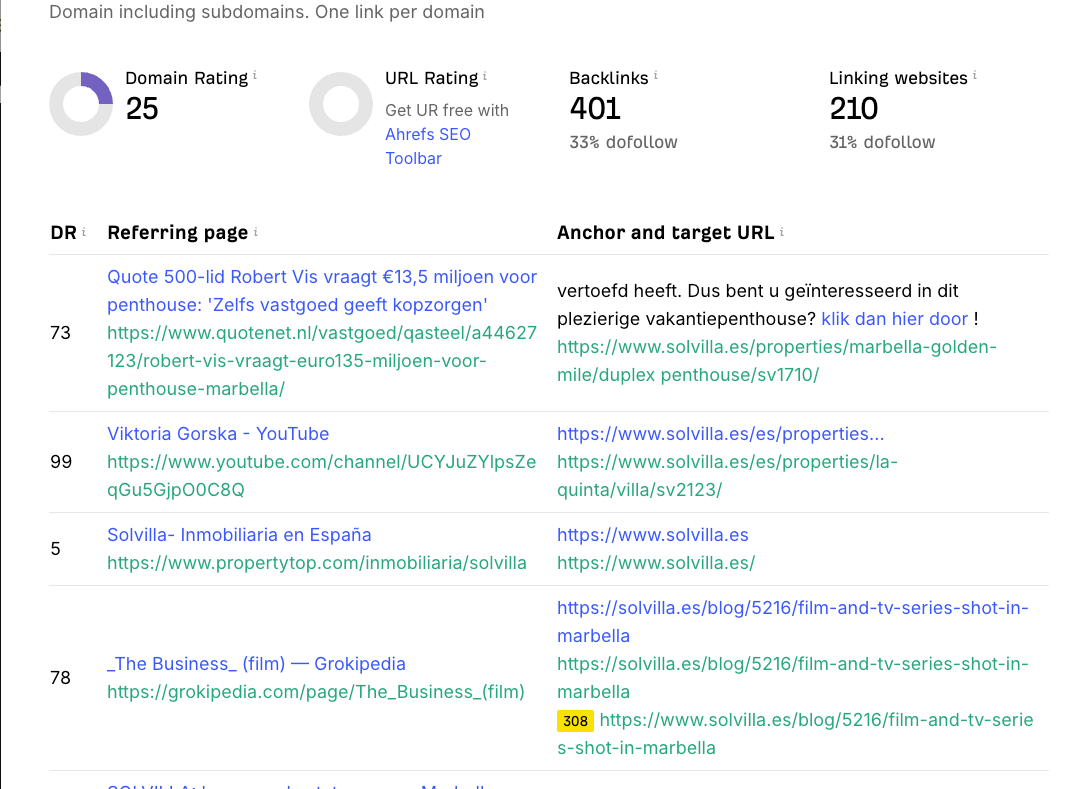
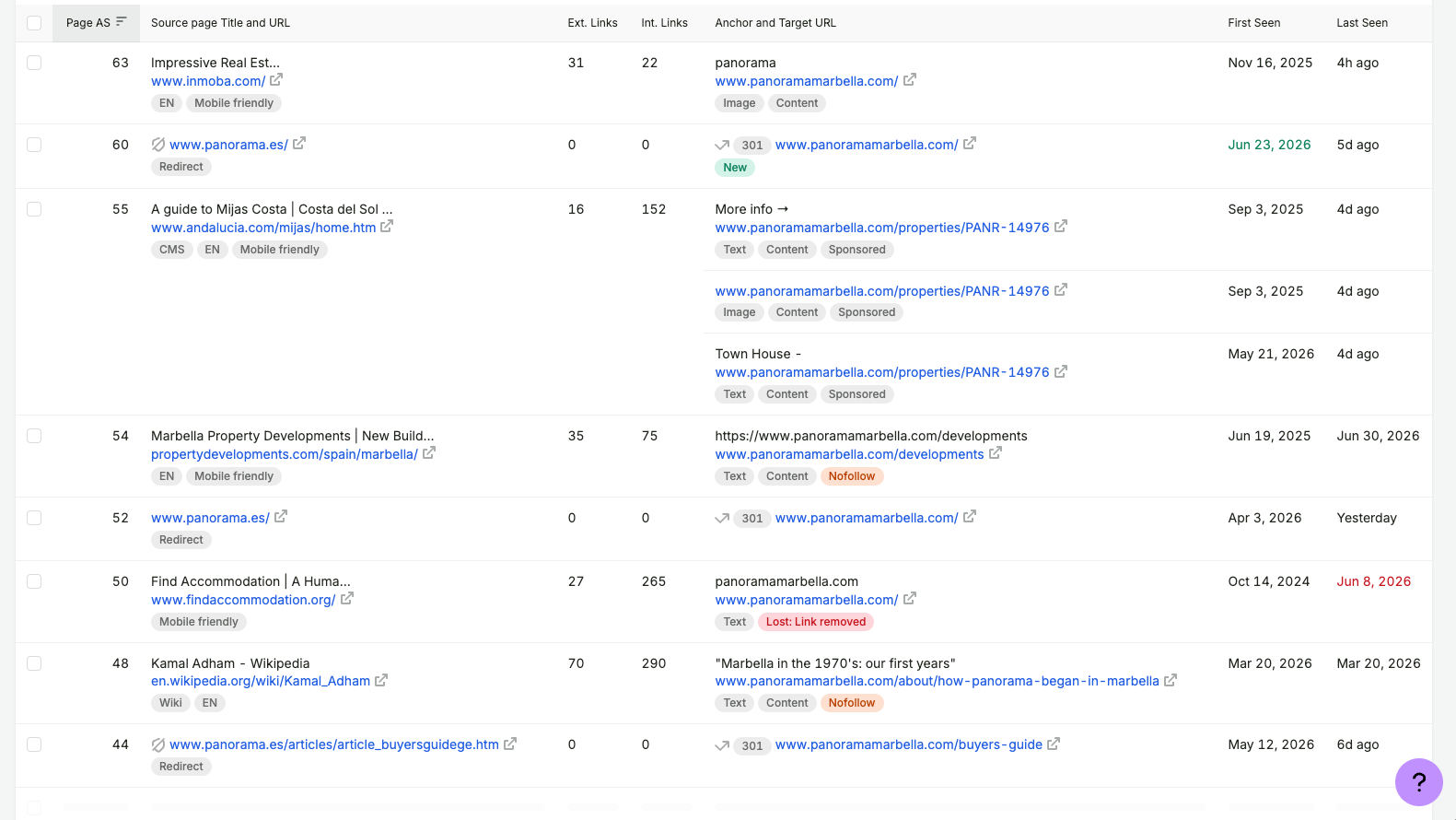
Link audit
Analyse who links to you, from where and in what context
A backlink profile should be assessed by relevance, diversity, stability and topical relevance. Ahrefs allows you to review referring domains, anchors, linked pages and profile development.
- Prioritise domains related to real estate, local life and housing.
- Avoid artificial patterns and repetitive anchors.
- Distribute links to profiles, areas, services and resources.
- Identify unlinked mentions that could become references.
- Compare growth with real competitors.
Sources of authority
What types of mentions are worth developing
| Source | Main value | Suitable content | Natural link |
|---|---|---|---|
| Industry directories | Validation of the company, area and services. | Complete agency or agent profile. | Corporate website or profile page. |
| Local websites | Geographic context and relevant audience. | Neighbourhood, housing and local-life guides. | Area page or specific resource. |
| Specialist media and blogs | Editorial reach and validation. | Market data, analysis or experience. | Source article or author page. |
| Professional collaborators | Trust and service network. | Legal, financial or relocation guides. | Related service, not always the homepage. |
| Professional networks | Brand, team and B2B relationships. | Corporate publications and case studies. | Business profile or cited resource. |
Topical authority
Publish resources that other websites can cite
The most valuable mentions usually come from content that provides something specific: data, comparisons, maps, checklists, processes or clear answers.
- Market studies with a clearly explained methodology.
- Area guides with practical information.
- Cost and process comparisons.
- Resources for international buyers.
- Downloadable checklists and calculators.
The strategy for real estate content that generates visibility and clients explains how to turn real questions into citable resources.
Profiles and consistency
Make your agency recognisable across every touchpoint
Professional directory
A profile in the real estate agency directory allows you to present areas, languages, services and specialisations in a structured way.
Google Maps
Review how the agencies in the Costa del Sol on Google Maps and keep the information consistent with your website.
Corporate LinkedIn
The presence of Roccabox on LinkedIn serves as an example of an active real estate brand in a professional environment.
E-E-A-T and authors
Experience must be linked to real people and processes
Every important guide should show who created it, what experience they have, when it was reviewed and which sources were used. The agency should also clearly explain its role, its limitations and when lawyers, advisers or technical professionals are involved.
Identifiable author
Name, role, experience and linked professional profile.
Review date
Especially important for taxes, legislation, financing and processes.
Reliable sources
Tools, organisations, data and references that support the explanation.
Clear limitations
Do not present general information as personalised legal, tax or financial advice.
To strengthen the technical and editorial structure, see how to rank a real estate agency in the Costa del Sol and how to connect the website with Google Maps and local searches .
The industry authority solution
Build a presence beyond your own website without losing consistency
RealtorList allows you to publish structured profiles for agencies and agents. Traffic Master combines a prominent presence with specialised content, contextual links and topic distribution.
Related reading
Connect authority, SEO, content and lead generation
Frequently asked questions
Digital authority for real estate agencies
There is no universal number. Relevance, diversity, context and quality are usually more important than volume alone.
Relevant directories can strengthen the entity and expand discovery points, especially when the profile is complete and consistent with the website.
They can strengthen trust and reputation, but they do not replace content, profiles, experience and external references. Nor do they guarantee rankings.
Artificial or irrelevant links may provide little value and create risks. It is preferable to build relationships, citable resources, profiles and relevant collaborations.
No. Traffic Master provides content, profiles and potential visibility. Rankings, mentions, traffic and enquiries depend on multiple external factors.
Actualidad inmobiliaria
Últimas publicaciones
Información práctica para agentes, agencias, compradores, vendedores e inversores del mercado inmobiliario español.

Capital gain on selling a property in España
Fiscalidad del vendedor · Ganancia patrimonial El impuesto no se calcula simplemente restando el precio de compra al precio de venta. Para determinar la gananci…
Leer más
How to calculate the return on a rental property
Inversión inmobiliaria · España Una buena inversión no empieza por la rentabilidad anunciada: empieza por entender todos los números y todos los riesgos. Compra…
Leer más
Scams and warning signs when buying a home in España
Seguridad inmobiliaria · España Una señal de alerta no demuestra una estafa, pero sí puede justificar detener el pago hasta verificar. Antes de entregar una res…
Leer más
Long-term or holiday rental: how to compare them
Inversión · Alquiler · Estrategia Larga temporada o alquiler turístico: compara primero la viabilidad y después la rentabilidad El alquiler turístico puede gene…
Leer más
Buying a property to invest in España
Inversión inmobiliaria · España Una buena inversión no empieza por la rentabilidad anunciada: empieza por entender todos los números y todos los riesgos. Compra…
Leer más
Buying a second home in España
Segunda residencia · España Una buena segunda vivienda debe funcionar también cuando no estás allí. Comprar una segunda residencia en España implica mucho más q…
Leer más
Tourist rental of residential properties in España
Inversión y alquiler · marco nacional Comprar para alquiler turístico no empieza con la rentabilidad. Empieza confirmando que el uso es viable. En España no exi…
Leer más
Where to buy a home in España: how to choose the right area
Elegir ubicación antes de elegir inmueble La zona adecuada no es la más famosa: es la que encaja con tu uso, presupuesto y forma de vida. España reúne mercados…
Leer más
Documents required to sell a property in España
Checklist documental del vendedor Preparar los documentos antes de encontrar comprador puede evitar retrasos cuando llega el momento de firmar. Para vender una…
Leer más
Withholding of 3% when selling a property as a non-resident
Vendedor no residente · IRNR El 3% que se retiene en la venta no es necesariamente tu impuesto final. Cuando un contribuyente no residente sin establecimiento p…
Leer más