
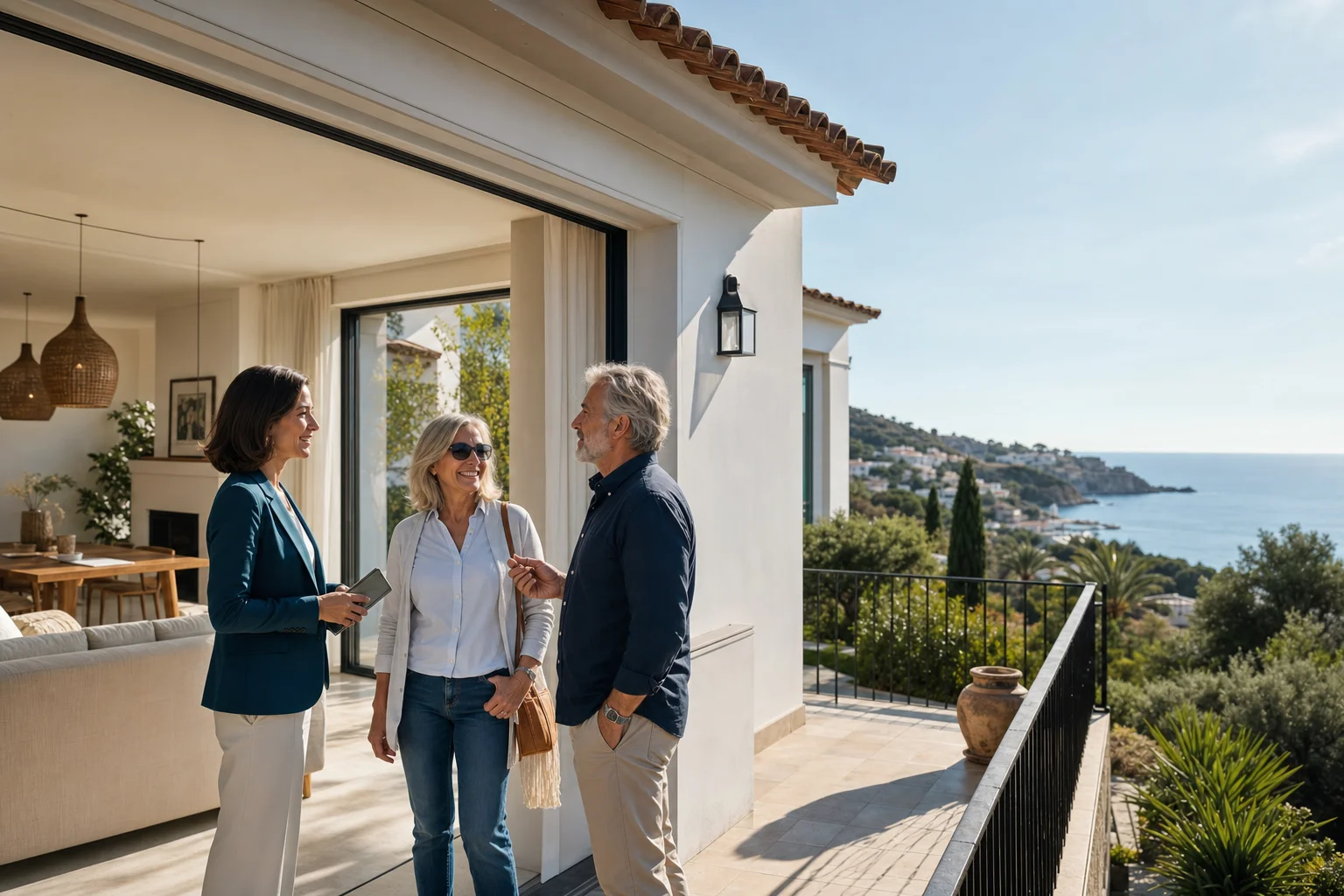
Retirement · Housing and lifestyle
A retirement home should work for you today and continue to do so as your needs change.
Buying a home in España for retirement is not just about choosing sun, beach or an attractive property. It is worth comparing healthcare services, daily life, transport, accessibility, year-round climate, recurring costs, community fees, maintenance, and ease of getting help or getting around. If you are also moving your residence to España, the property purchase should be assessed separately from immigration matters, healthcare and tax residency.
Short answer
There is no single “best area in España for retirement” that suits everyone
An excellent area for an active person with a car may be impractical for someone else who prioritises walking, public transport or proximity to a hospital. The right decision starts with your expected daily life and then filters the location, property type and budget.
Health and services
The health centre, hospital, pharmacy, supermarket and everyday services should be assessed by actual travel time, not just distance on a map.
Mobility
Slopes, pavements, lifts, public transport, taxis and the need for a car can radically change how convenient an area is.
Annual cost
In addition to the purchase price, you should budget for community fees, local taxes, insurance, utilities, maintenance and potential major repairs.
Ten-year test
Ask yourself whether you would still choose the same home with reduced mobility, less desire to drive or a greater need for nearby services.
The useful question is not “where would I like to spend two weeks?”, but “where could I live well on an ordinary Tuesday in January ten years from now?”.
Before buying
Buying a home and obtaining residence in España are separate legal decisions
Owning a home does not in itself create a right of residence. The applicable route depends, among other factors, on nationality, personal circumstances and the type of permit that applies.
EU, EEA and Switzerland
For residence exceeding three months, people who do not work in España may qualify under the provisions for sufficient resources and health insurance covering risks in España. Resources are assessed individually.
Non-EU nationals
One possible route for certain profiles is an initial non-lucrative temporary residence permit, which allows residence without undertaking employment or professional activity and requires, among other conditions, sufficient financial means and healthcare cover under the current official requirements.
Buying a property no longer provides access to the real-estate “golden visa” route
The provisions of Law 14/2013 concerning visas and residence permits for investors ceased to have effect effective 3 April 2025. Transitional rules exist for certain prior applications and permits.
If your goal is to live in España on a long-term basis, confirm the applicable immigration route before committing a substantial part of your assets to a home.
Healthcare
Living near a hospital is of little use if you have not resolved how you will access healthcare
Access to healthcare depends on each person's status and coverage. For economically inactive EU/EEA/Swiss citizens residence regulations require healthcare coverage where applicable. The Ministry of the Interior also states that pensioners meet this requirement when they provide certification of entitlement to healthcare funded by the State that pays their pension.
- Confirm your entitlement or insurance before choosing an area for its “good healthcare”.
- Check the primary care centre, designated hospital and on-call pharmacy.
- Consider travel time without a car and alternatives if you are unable to drive.
- If you are entitled to international healthcare coordination, check the applicable official procedure, including registration of the S1 form where appropriate.
- Do not confuse property ownership with entitlement to access healthcare.

The correct route depends on your residence status, Social Security entitlements, the State paying your pension and other circumstances. Avoid turning a common expatriate practice into a universal legal rule.
Tax residence
Spending more time in España can change far more than your home address
Buying a property does not in itself determine tax residency. According to the Spanish Tax Agency, a person may be a tax resident in España, among other circumstances, if they spend more than 183 days during the calendar year or if the main centre or base of their activities or economic interests is located in España.
Days in España
Spending more than 183 days in the calendar year is one of the current legal criteria, with rules on occasional absences.
Economic interests
The number of days is not the only criterion: where the main centre or base of activities or economic interests is located may also be relevant.
Pensions and income
If your tax residency changes, the taxation of pensions and other foreign income should be reviewed according to the type of income and, where applicable, the relevant international tax treaty.
The Spanish Tax Agency considers more than one criterion, and each situation must be assessed based on its facts and, where applicable, the relevant double taxation treaty.
Choosing where to live
Compare the area as a resident, not as a tourist
Coastal areas, cities, islands and inland locations can all work very well for different profiles. In retirement, the suitability of a location depends less on its reputation and more on the specific combination of services, mobility, housing and social network.
| What to assess | Practical question | Positive sign | Potential risk |
|---|---|---|---|
| Healthcare | How would I get to an appointment or emergency care if I could not drive? | Several access options and nearby services. | Reliance on a single long car journey. |
| Daily life | Can I buy groceries, go to the pharmacy and run errands on foot? | Year-round services within a reasonable distance. | An isolated or highly seasonal development. |
| Connectivity | What happens if family or friends live outside España? | Road links, public transport and reasonable access to an airport or rail service, depending on needs. | Complicated journeys that ultimately reduce visits. |
| Topography | Is the slope still manageable with reduced mobility? | Level routes or accessible alternatives. | Stairs, steep hills and few nearby services. |
| Seasonality | What is the area like in January and August? | Activity, neighbours and services throughout the year. | An area that is deserted in winter or overcrowded during peak season. |
| Social life | Do I have real opportunities to establish a routine and build a community? | Suitable activities, associations, languages and meeting places. | Choosing solely based on the property without considering life outside the home. |
Year-round climate
“Good weather” does not mean the same thing for every property or every season
Orientation, ventilation, shade, insulation, humidity, wind and sun exposure can matter as much as the average temperature of a province. Two very nearby properties can feel very different.
- Visit the area in more than one season whenever possible.
- Check winter sunshine and protection from heat in verano.
- Assess insulation, heating and cooling, and ventilation, especially if you will live there year-round.
- Check humidity, wind, orientation and noise with windows open and closed.
- Ask about the actual costs of heating, cooling and maintenance, not just the regional climate.
The value of a retirement home lies in how you live in and around it every day: indoor temperature, accessibility, maintenance, light, noise, services and ease of leaving the house.
Choosing the type of property
Apartment, townhouse or villa: the best option depends on how much independence and maintenance you are willing to take on
Apartment
It can reduce private maintenance and bring you closer to amenities, but you should check the lift, accessibility, homeowners’ association, special assessments, noise and community rules.
Townhouse
It can offer more space and outdoor areas with a moderate level of maintenance. Internal stairs and multi-storey layouts deserve special attention.
Detached villa
It offers privacy and control, but the garden, pool, security, repairs and travel can increase the management burden and annual cost.
Check for steps from the street, a lift, doorway widths, and whether the main bedroom and bathroom are on the same floor, as well as the shower, parking access and whether the property can realistically be adapted if necessary.
Ask who would take care of shutters, climate control, the pool, garden, waterproofing, façade, the lift or repairs if you did not want to manage them personally.
A sustainable budget
The purchase price is only the beginning: retirement requires a realistic annual budget
There is no universal percentage that represents the annual costs of a property in España. They depend on the municipality, homeowners' association, property, use, insurance, utilities and the owner's tax situation.
Community
Regular fees, shared services and potential special assessments. Pools, gardens, security and lifts can increase the budget.
Local costs
IBI and other municipal charges or services depend on the municipality and should not be extrapolated from another locality.
Maintenance
Repairs, climate control, painting, façades, pool, garden, appliances and periodic replacements.
Taxation
The purchase, ownership and eventual sale each involve different tax considerations. Tax residence and autonomous community may be relevant depending on the tax.
Try before you decide
Temporarily renting in the area can reveal issues that a viewing does not show
If retirement involves a major move, spending time in the area before buying can help you assess traffic, noise, weather, social life, transport, services and everyday routines.
- Do a normal grocery shop, not just eat at restaurants.
- Try the route to the pharmacy, health centre and hospital.
- Drive or use public transport at normal times and during high season.
- Walk the routes you would normally use during the day and at night.
- Check which shops and services remain open out of season.
A home used for several weeks a year can tolerate more isolation, stairs or maintenance than a property pensada for use as a primary residence for many years.
Decision-making examples
The same property may be excellent for one retiree and impractical for another
Active couple with a car
They may accept greater distance from amenities in exchange for outdoor space, peace and quiet, and sporting activities, provided maintenance remains manageable.
Person living alone
They may prioritise a year-round community, walkable amenities, transport, practical security, and ease of asking for help or receiving visitors.
Family in another country
Airport or rail connections may matter more than a few extra square metres of living space if they make frequent visits easier.
Limited mobility
A lift, step-free access, level ground, an adaptable bathroom and nearby amenities may take priority over views or size.
Common mistakes
The most costly mistakes often start with a convenient assumption
Choosing based on views alone
A great view does not necessarily compensate for slopes, isolation, noise, no lift or distant amenities.
Buying after a holiday
The holiday experience can conceal seasonality, traffic, humidity, heat, cold, noise or the closure of amenities.
Confusing ownership with residency
Property ownership alone does not create a right to reside or access healthcare.
Using 183 days as the only rule
Tax residence has more than one criterion; the centre of economic interests may also be relevant.
Ignoring special assessments
A building with a lift, façade, roof or shared facilities may generate future extraordinary expenses.
Overestimating the desire to drive
An isolated residential development may become less practical el paso over time, even if driving is not a problem today.
Buying too much house
More square metres, a garden and a pool also mean more cleaning, maintenance, repairs and management.
Failing to check legal compliance and encumbrances
Retirement plans do not reduce the need for due diligence regarding the Land Registry, Catastro, planning, community and contractual matters.
Final checklist
The retirement test: 12 questions before booking
Daily life
- Can I live without a car for several days?
- Are the supermarket and pharmacy open all year round?
- Does the area allow me to build a social routine?
- Can family and friends get there reasonably easily?
Property
- Are there difficult steps or steep slopes?
- Are the main bedroom and bathroom accessible?
- Can I maintain the garden, pool and terraces?
- Does the community have any major works planned?
Administration and costs
- Is my immigration residency status sorted out?
- Do I know how I will access healthcare?
- Have I reviewed my tax residency and pensions?
- Is the annual budget still comfortable, with room for unexpected expenses?
Verified official sources
Residency, healthcare and taxation should be based on public sources, not property-sector promises
Last verified: 9 August 2026. Immigration procedures, documentation requirements and tax criteria should be reviewed again when submitting an application or making a tax decision.
Related guides
Continue with the specific question you need answered
Search based on your actual needs
For retirement, local knowledge is most valuable when combined with the right specialty
An agency or agent can help you compare areas, access, the market and properties. Matters relating to residency, taxation, healthcare, contracts or technical matters may also require independent specialists. Relevance should be based first on location, service, language and property type.
Frequently asked questions
Buying a home in España for retirement
No. Property ownership and residency rights are separate matters. In addition, the provisions of Law 14/2013 concerning visas and residence permits for investors ceased to have effect as of 3 April 2025, without prejudice to its transitional rules for certain earlier cases.
A right of residence for more than three months may exist where the requirements of the applicable regime are met. For EU/EEA/Swiss nationals who do not work in España, the regulations require sufficient resources and health cover; the documentation and exact circumstances should be confirmed before moving.
One possible route for certain third-country nationals is an initial non-lucrative temporary residence permit, which allows residence without employment or professional activity and requires compliance with the current requirements for financial means, health insurance and other conditions. It is not an automatic permit obtained by buying a property.
No. Access to healthcare depends on a person's status and entitlements, not on property ownership. Some pensioners may be able to demonstrate cover paid for by the state that pays their pension and, where applicable, use coordination mechanisms such as the S1 form.
Spending more than 183 days during the calendar year is one of the tax residence criteria published by the Tax Agency. Rules on occasional absences and other legal criteria applicable to the case must also be considered.
It should not be treated as an automatic guarantee. The regulations also consider where the main centre or base of a person's economic activities or interests is located, and international treaties may apply in cases of dual residence.
There is no single area that is best for everyone. It is advisable to compare healthcare services, mobility, year-round climate, connections, housing and maintenance costs, the local community, language, noise, seasonality and future needs.
It depends on the individual profile. An apartment may simplify some maintenance, but it also involves the owners' community, lifts and possible special assessments. A villa offers privacy and space, but may require more management of the garden, pool, security and travel. Future accessibility should be a factor in both cases.
It can be a useful way to experience everyday life in the area before committing capital: services, transport, noise, climate, traffic, community and seasonality are easier to assess by living there than during a short visit.
Access from the street, steps, lift, slopes in the surrounding area, main bedroom and bathroom, shower, parking, proximity to services and the possibility of living without driving. It is also advisable to check whether the property can be adapted without disproportionate building work.
Actualidad inmobiliaria
Últimas publicaciones
Información práctica para agentes, agencias, compradores, vendedores e inversores del mercado inmobiliario español.
Capital gain on selling a property in España
Fiscalidad del vendedor · Ganancia patrimonial El impuesto no se calcula simplemente restando el precio de compra al precio de venta. Para determinar la gananci…
Leer más
How to calculate the return on a rental property
Inversión inmobiliaria · España Una buena inversión no empieza por la rentabilidad anunciada: empieza por entender todos los números y todos los riesgos. Compra…
Leer más
Scams and warning signs when buying a home in España
Seguridad inmobiliaria · España Una señal de alerta no demuestra una estafa, pero sí puede justificar detener el pago hasta verificar. Antes de entregar una res…
Leer más
Long-term or holiday rental: how to compare them
Inversión · Alquiler · Estrategia Larga temporada o alquiler turístico: compara primero la viabilidad y después la rentabilidad El alquiler turístico puede gene…
Leer más
Buying a property to invest in España
Inversión inmobiliaria · España Una buena inversión no empieza por la rentabilidad anunciada: empieza por entender todos los números y todos los riesgos. Compra…
Leer más
Buying a second home in España
Segunda residencia · España Una buena segunda vivienda debe funcionar también cuando no estás allí. Comprar una segunda residencia en España implica mucho más q…
Leer más
Tourist rental of residential properties in España
Inversión y alquiler · marco nacional Comprar para alquiler turístico no empieza con la rentabilidad. Empieza confirmando que el uso es viable. En España no exi…
Leer más
Where to buy a home in España: how to choose the right area
Elegir ubicación antes de elegir inmueble La zona adecuada no es la más famosa: es la que encaja con tu uso, presupuesto y forma de vida. España reúne mercados…
Leer más
Documents required to sell a property in España
Checklist documental del vendedor Preparar los documentos antes de encontrar comprador puede evitar retrasos cuando llega el momento de firmar. Para vender una…
Leer más
Withholding of 3% when selling a property as a non-resident
Vendedor no residente · IRNR El 3% que se retiene en la venta no es necesariamente tu impuesto final. Cuando un contribuyente no residente sin establecimiento p…
Leer más